

LED mask at home or LED in a clinic: what are the differences?
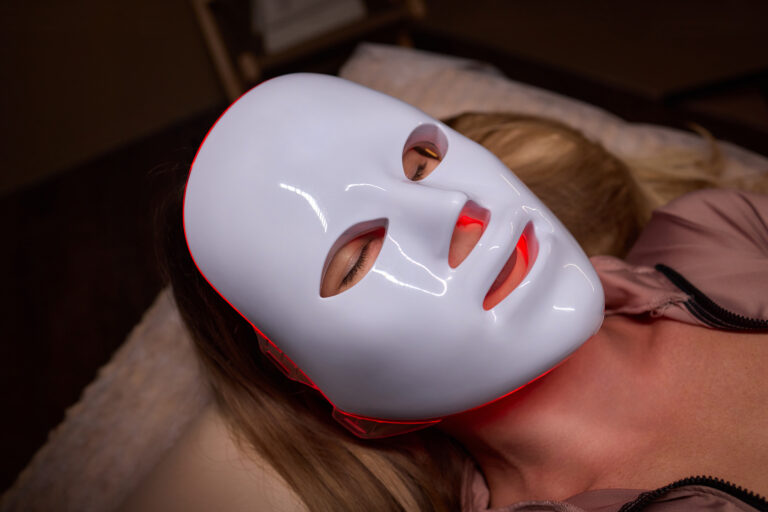
LED face masks have become extremely popular. But do they actually work? And can you expect the same results from a mask used at home as from an LED session performed in a clinic?
LED masks have become widely available in recent years. Once primarily reserved for dermatologists' offices and clinics, LED phototherapy is now offered in the form of masks and devices designed for home use.
The technology is not new, however. LEDs have been used for several decades in photobiomodulation, a technique that involves exposing the skin to certain wavelengths of light in order to trigger biological responses at the cellular level.
Available studies suggest, in particular, that certain wavelengths may be beneficial in improving some signs of skin aging, supporting healing, or contributing to the management of certain forms of acne.
But not all LEDs are created equal.
The wavelength used, the power delivered to the skin, the duration of exposure, the distance between the light source and the face, and the repetition of sessions all have a significant influence on the result.
This is why a home LED mask and a device used in a clinic should not be considered strictly equivalent.
How does an LED actually work on the skin?
Unlike a laser, an LED does not deliver a beam of light concentrated on a precise target.
It emits low-intensity light corresponding to one or more wavelengths. Some of these are capable of penetrating tissues and interacting with cells.
This is referred to as photobiomodulation.
For red light and near-infrared in particular, one of the main scientific hypotheses is based on an interaction with mitochondria, which are in a way the power plants of our cells.
This stimulation will alter several cellular mechanisms, including ATP production and various signaling pathways involved in inflammation, tissue repair, and cellular activity.
The goal is therefore not to heat or burn the skin as some lasers or energy-based devices can do.
Photobiomodulation, on the other hand, relies on the use of relatively low energy.
And that is precisely one of the peculiarities of LEDs: more power does not necessarily mean more efficiency.
Photobiomodulation operates on a dose-response basis. Too low an exposure may be insufficient, but excessively high an exposure does not necessarily produce a better result.
“With LEDs, we need to move away from the idea that the more powerful a machine is, the more effective it will be. What matters is delivering the right wavelength, with the right dose, and for the right duration.” — Dr. Chirine Rezzag, dermatologist, Clinique Renécia
What are the different LED colors used for?
Not all the colours found on some masks have the same level of scientific evidence.
The wavelengths best studied in dermatology are primarily red, near-infrared and, in certain indications, blue.
What is the difference between an LED mask for home use and an LED mask used in a clinic?
The physical principle may be the same: in both cases, it may involve actual LEDs delivering a given wavelength.
The main difference lies in the technical characteristics of the device and the protocol used.
Devices intended for the general public are generally designed to be easy and safe to use without medical supervision. Their power is therefore often more limited than that of professional devices.
In clinical practice, it is also possible to precisely control several parameters:
- the wavelengths used;
- Irradiance, that is to say the amount of light power received by a given surface;
- the duration of exposure;
- the total dose delivered;
- the distance between the skin and the light source;
- the number and pace of the sessions.
This last point is essential.
Photobiomodulation does not depend solely on the color of the light. Two devices both displaying "red LED 633 nm" can deliver very different doses to the skin.
At Clinique Renécia, Dr. Chirine Rezzag therefore considers LED therapy as a true protocol rather than simply exposure to red light.
“The question isn’t simply, ‘Does this machine emit red light?’ We need to know how much energy actually reaches the skin and according to what protocol.” — Dr. Chirine Rezzag, dermatologist, Clinique Renécia
Do LED masks for home use really work?
Yes, some may work.
It would be excessive to oppose an LED in a clinic that would be effective to masks at home that would not be.
Several controlled studies have shown that a properly designed and regularly used home LED device can improve certain signs of skin aging or help reduce certain inflammatory acne lesions.
A randomized study published in 2025, for example, found an improvement in crow's feet wrinkles with a mask combining red LED at 630 nm and near infrared at 850 nm after several weeks of regular use.
A meta-analysis published the same year in JAMA Dermatology also found favorable data regarding certain LED devices used at home for acne.
The main problem is therefore less the concept of the LED mask than the extreme heterogeneity of the devices available on the market.
Two masks that look very similar can have very different performances.
Is a mask costing 500 euros necessarily better than a mask costing 100 euros?
No.
Price is not a scientific indicator of performance.
Similarly, the number of LEDs on the mask alone does not determine whether the device will be effective.
To properly evaluate a device, ideally one should know:
- the exact wavelength(s);
- irradiance in mW/cm²;
- the dose delivered in J/cm² during a session;
- the recommended duration of use;
- the actual distance between the LEDs and the skin;
- clinical studies conducted with the device itself.
However, this information is not always easily accessible.
A manufacturer can advertise "600 LEDs" without clearly communicating the amount of energy that actually reaches the skin.
Conversely, a device containing fewer LEDs can perfectly deliver a coherent and properly studied protocol.
Commercial terms such as "professional grade" or "medical grade" should therefore not replace the analysis of the actual characteristics of the device.
What results can we realistically expect in terms of wrinkles and skin quality?
The available data is encouraging, but here again we must distinguish between improvement in skin quality and true correction of skin aging.
Clinical trials have observed, after several weeks of red photobiomodulation, an improvement in parameters such as fine lines, texture, or certain collagen markers.
In a randomized trial involving 137 women, ten photobiomodulation sessions carried out over four weeks with red light at 660 nm resulted, for example, in a measured reduction in the volume of periocular wrinkles.
Other studies using red and near-infrared wavelengths have also shown changes in collagen and skin elasticity.
But LED therapy remains a relatively gentle treatment.
It can be useful for gradually improving skin quality, maintaining certain results or complementing other treatments.
However, it should not be presented as an equivalent alternative to laser resurfacing when a patient wishes to treat deep wrinkles, significant loss of firmness or scars.
Why are LEDs often used after laser treatments, peels, or certain other treatments?
Photobiomodulation is particularly interesting when used in conjunction with other dermatological procedures.
Red light and near-infrared are being studied for their ability to intervene in various mechanisms related to inflammation and tissue repair.
A LED session may therefore be offered after certain treatments to support skin recovery.
However, the benefit depends on the care provided.
An LED is not systematically necessary after every cosmetic procedure and it obviously does not replace the post-procedure care prescribed by the doctor.
At the Renécia clinic, its use can therefore be integrated into a global protocol when it is of interest for the patient's skin or for the treatment that has just been carried out.
Home LED mask or LED in a clinic: do we really have to choose?
Not necessarily.
The two uses can be complementary.
An LED used in a clinical setting allows working with a professional device, a defined protocol and above all an indication based on the patient's skin.
A good home mask can then be beneficial for some patients to prolong this stimulation on a regular basis.
But you have to keep in mind a simple rule: the best LED is not necessarily the one that emits the most light, the one that has the most colours or the one that costs the most.
It is the one whose parameters are consistent with the objective sought and whose protocol is correctly followed.
“I’m not at all opposed to at-home LED masks. Some are interesting. But they should be considered a tool for regular skincare and not a machine capable of replacing all dermatological treatments.” — Dr. Chirine Rezzag, dermatologist, Clinique Renécia
For Dr. Chirine Rezzag, LEDs are therefore most useful in a comprehensive approach to skin quality: alone when gentle stimulation is desired, as a complement to a dermatological protocol or for home maintenance when the device is correctly chosen.
The key is to start with the skin and the patient's indication rather than the technology itself.